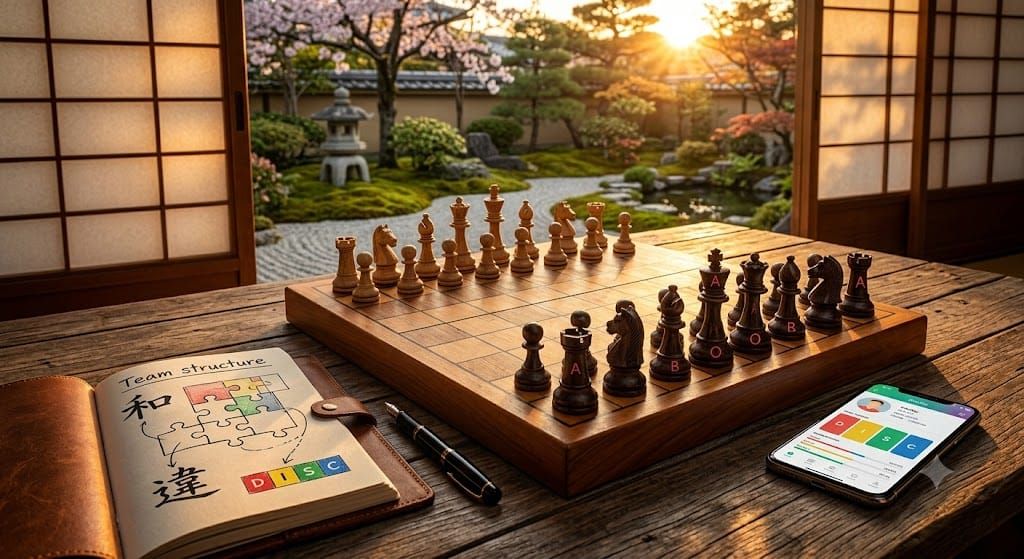
The goal is always the same: to build a team like a jigsaw puzzle. Every piece must have a different shape so that, when they all come together, they create one complete picture. Today, this is recognized as one of the key principles of modern management and organizational psychology, known as cognitive diversity. True success comes from balance and complementarity.
There is a well-known saying in business, often attributed to William Wrigley Jr.: "If two people in a room always think alike, one of them is unnecessary." A similar idea was later popularized by the legendary American World War II General George S. Patton, who said: "If everyone is thinking alike, then somebody isn't thinking." Both quotes perfectly illustrate what modern management strongly emphasizes today - the value of diversity within a team.
One of the biggest mistakes I made early in my career was hiring people who were too much like me. I wasn't even aware of it until, over time, I realized that my team lacked analytical thinkers and people who were naturally more cautious about taking risks. This mistake even has a name: groupthink. The term was first introduced by the American sociologist and journalist William H. Whyte Jr. in a 1952 article for Fortune magazine. It was later scientifically developed by social psychologist Irving Janis in his 1972 landmark book Victims of Groupthink, where he explored how groups of highly intelligent people, driven by the desire for harmony and conformity, often make poorer decisions than they would as individuals. Just like I did.
Read next: Cultural Compatibility - The Hidden Rh Factor of Successful Acquisitions
Eventually, I realized that everyone in my team looked at problems in exactly the same way. Nobody questioned the manager's decisions because we all shared the same perspective. Worst of all, creativity slowly disappeared because there were no opposing viewpoints to spark meaningful discussion.
One of my favorite profiling tools has always been the DISC model, which personally helped me tremendously in sales. DISC is not a scientifically validated personality model, but for me it was an excellent practical tool for adapting my communication style. Especially at the beginning of my career in the pharmaceutical industry, when I would visit up to ten medical specialists in a single day. When you only have ten or fifteen minutes with someone, your brain naturally looks for patterns. Mine would instinctively categorize people according to the DISC model. Of course, none of us is just one color, and people should never be reduced to simple labels. Human personality is far too complex to fit neatly into a single category. Even so, this simple framework made it much easier for me to adjust my communication style depending on the doctor I was speaking with. And I have to admit, I was remarkably successful. Even today, I sometimes catch myself thinking, "Hmm... this one is definitely a Blue."
While many of us use DISC, other cultures have developed completely different ways of interpreting human behavior. In Japanese business culture, one such concept is known as Ketsueki-gata, or Blood Type Management. In 1927, Japanese professor Takeji Furukawa published a paper claiming that blood types influenced human temperament. Although his theory had no scientific foundation, it quickly captured public attention. During World War II, it was even rumored that the Japanese military used blood type theory when organizing military units. The real boom, however, came during the 1970s when journalist Masahiko Nomi published a series of bestselling books claiming that a person's blood type determines their personality, behavior, and even their destiny.
It is important to emphasize that this is purely a cultural phenomenon and a popular belief with no scientific evidence supporting it. It reflects social dynamics rather than being a legitimate tool for assessing people's abilities or potential.
Today, blood types in Japan are mostly used as a fun conversation starter. However, the phenomenon also has a darker side known as bura-hara (short for blood harassment). People with blood type B or AB have sometimes faced prejudice at work or in school because they are stereotyped as selfish, unpredictable, or eccentric. Some companies even asked job applicants about their blood type, supposedly to assess whether they would fit into the team, prompting the Japanese government to discourage such hiring practices. Overall, blood types remain deeply embedded in everyday Japanese culture and represent a fascinating example of how modern biology evolved into a pop-cultural phenomenon.
Simply put, if your team consists entirely of analytical, risk-averse people, your projects will likely be flawless and well-executed, but your company may never launch an innovative product because everyone is afraid of taking risks. On the other hand, if your team is made up entirely of visionaries and creative thinkers, you'll have a million brilliant ideas, but none of them may ever be completed because nobody enjoys dealing with spreadsheets, administration, and routine execution.
Today, I no longer look for people who simply confirm my opinions. I look for people who challenge them. Not because I enjoy arguments, but because I know that different perspectives reveal what I cannot see on my own. The best team is not the one where everyone thinks alike. The best team is the one where every person brings something that the others lack. Just like a perfectly assembled jigsaw puzzle.