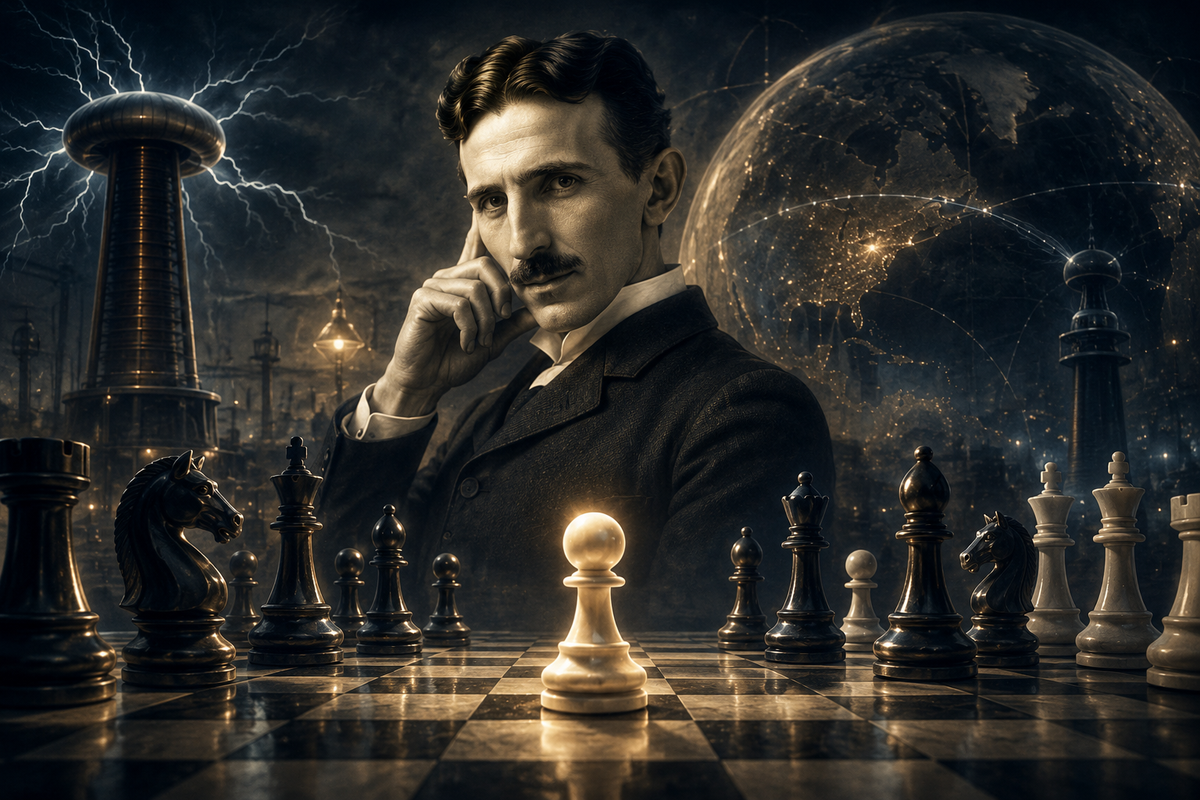
While people across the Balkans still argue today over who Nikola Tesla belongs to, perhaps a more important question is this: what enabled a boy from a small village to change the world? The Habsburg Monarchy educated him, the land that is today Croatia and Serbia gave him his identity, and America gave him capital. Exactly 170 years ago, on July 10, 1856, a genius was born in the small village of Smiljan near Gospić, then part of the Military Frontier of the Austrian Empire (today Croatia).
Discussions about Tesla often focus on his Orthodox priest father or his professors, while his mother, Georgina (Đuka), is rarely mentioned. Đuka was an extraordinary woman. Without a single day of formal education, in that small Lika village in the nineteenth century, she was a first-class innovator within her own household. Tesla often said that he inherited his gift for invention from his mother. She created numerous household tools, knitted and wove highly complex patterns, and possessed an extraordinary memory. She knew thousands of verses of traditional folk poetry by heart. Đuka is a perfect example of how creativity and intelligence do not always depend on formal education, but on the way we observe and solve the problems around us. While Tesla inherited his inventive gift from his mother, he believed he inherited his exceptional memory and talent for languages from his father.
Tesla's life is a perfect example of one of psychology's oldest debates: nature versus nurture - which shapes us more, our genes or our environment? From his parents, who came from the Lika region, Tesla inherited extraordinary cognitive abilities, an exceptional memory and the ability to construct complex inventions almost entirely in his mind before ever building them in reality. But that "hardware" would have been useless without the right "software" and the right environment. Psychologists call this the reaction range: genes determine the limits of our potential, but the environment determines how close we come to reaching it. Had Tesla remained in his homeland, his genes might have made him nothing more than a remarkably skilled village inventor. It was only when he arrived in New York, surrounded by capital, visionaries, and fierce industrial competition, that his full potential was able to emerge.
In short, we may have the greatest talent in the world, but if we place it in the wrong environment, innovation will never happen. The environment in which we live and work determines whether our inner genius will flourish or remain nothing more than untapped potential. For Tesla, it was precisely the change of environment, his move to America, that allowed him to reach his full genetic potential and change the world.
The same applies to organizations. Exceptional talent is rarely the problem in itself. The problem begins when an organization lacks the capacity to recognize what it actually has in front of it. Brilliant people rarely leave because they aren't talented enough. More often, they leave because they work in systems that neither recognize nor know how to develop their potential.
Most people in business are driven by external rewards - money, fame, status, security. Tesla was a brilliant innovator, but a very poor businessman. Unlike Edison, who was an excellent businessman and knew how to sell a product, Tesla largely ignored the financial side. A brilliant idea alone is never enough without a sustainable business model. On top of that, he sold many of his patent rights, including those related to alternating current, to George Westinghouse in order to save other people's companies or finance new projects, giving up what could have become enormous future royalty income. Tesla was a perfect example of an autotelic personality. For him, the reward lay in the very act of creating and discovering the truth. When a person's only goal is to advance humanity, society's approval becomes far less important. He did not need the world to validate the value of his ideas because, in his own mind, he had already seen that what he was creating worked and would one day change the world.
When people do not understand you, it usually hurts. But Tesla did not experience that pain in quite the same way because he knew they simply could not see what he saw. From a psychological perspective, his inner world of visions was more real and tangible than the external world surrounding him. While his contemporaries in late nineteenth-century New York were thinking about gas lamps and steam engines, he was already envisioning wireless energy transmission, global communication, and devices that today resemble smartphones and the internet.
What fascinates me about Tesla more than all of his inventions is that focus. He lived entirely inside his own vision. The outside world, with its money and social status, was secondary; his true playground was the world of ideas. It seems to me that he lived on a rare level of existence where one no longer works for profit, but for eternity. And that is exactly why we should be grateful to him today. Because if Tesla had not had the courage to be misunderstood in his own time, our modern world would look completely different. He was a visionary who sacrificed his present so that he could give us our future.
Yet today, ninety years after his death, people still argue on the internet over who he belonged to. Back in 1936, Tesla had already demonstrated remarkable emotional intelligence and breadth of mind. He was proud of his roots, but equally proud of the country where he was born and raised. In May 1936, on the occasion of Tesla's eightieth birthday, Dr. Vladko Maček - the Croatian political leader at the time, sent Tesla a congratulatory message in New York. Tesla immediately replied with a telegram that has since become a historical classic: "Thank you for your touching congratulations. I am equally proud of my Serbian origin and my Croatian homeland. Long live all Yugoslavs. Nikola Tesla."
Perhaps that is precisely why it no longer matters whose Tesla was. What matters is who his legacy belongs to today, and that legacy belongs to all of humanity. Let that be the lesson. Just like Tesla, you may come from a small village, while your impact and your market can be completely global.