Whenever I find myself facing something completely unknown to me, yet for some reason deeply appealing, the same attitude always emerges within me: I know I can do it. I don't know how, but I know I can, and I go for it.
I remember jumping into the sea from piers when I was a child. Wherever I happened to be, I would simply run and jump, without asking questions or thinking about how deep the water was or what might be waiting for me below. That absolute trust I had as a child was incredible. And it was not only from piers, but also from high rocks, where I would pull on my friends' enormous size 45 trainers over my little size 37 feet, convinced that somehow they would soften my jump into the sea and stop me from sinking too deeply. Of course, wearing those trainers only made me sink faster and deeper, but at that moment they were my shield, something I believed would protect me. Perhaps we spend our entire lives doing exactly the same thing. We pull on our own metaphorical size 45 trainers - titles, plans, security, other people's approval, convinced that they will protect us from the depth, and then life very quickly shows us that some of the things we believed would keep us afloat actually do nothing more than make the weight we carry heavier.
And I miss that. Because today, before I jump, I look and check first. I don't give up, but I do my checks. And somehow I tend to avoid jumping from really high rocks altogether, unless I find myself in one of those "crazy" moments when I say to myself, Come on, just do it!, and then, practically dying of fear, I jump.
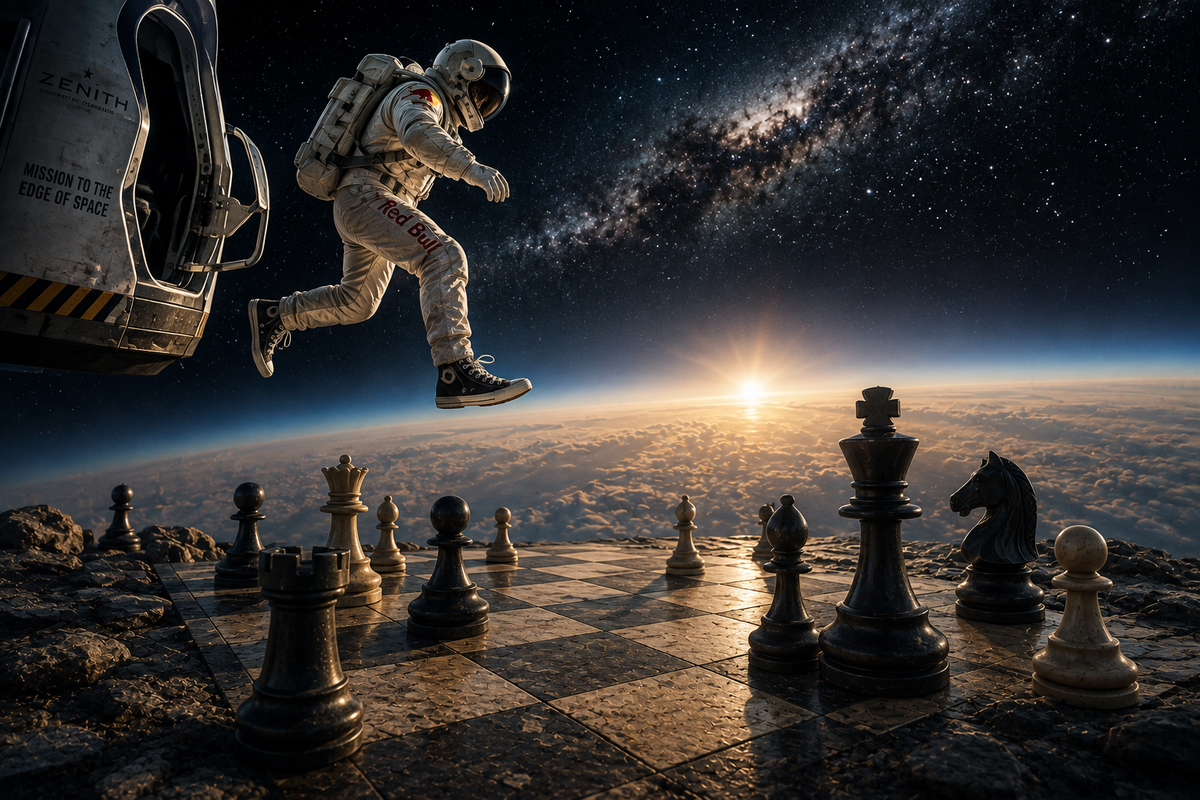
When Felix Baumgartner stood at the edge of a capsule almost 39 kilometres above the Earth in 2012, he was looking into the emptiness beneath him. No one before him had ever jumped from such an altitude, and no one before him had ever broken the sound barrier with their own body in free fall, without propulsion or the protection of a vehicle. There was no one who could sit down with him and, drawing from their own experience, describe in detail every second of the journey that was waiting for him.
His jump was not only about physics and technology; it was a leap into the completely unknown. When he stepped out and soon entered an uncontrolled and dangerous spin at a speed of more than 1,300 km/h, there came a moment in which control could very easily have been lost. But that is precisely when everything we have built within ourselves comes into play: calmness, persistence, and trust in the process. Felix managed to stabilise his body, break the sound barrier, and land safely back on Earth. His jump gave science new data, but it left the rest of us with something else, a reminder that the boundaries of what is possible are sometimes much farther away than we think.
Read next: Life’s Gambit: A Bold Choice That Changes Everything
Every leap we make into something new in life, whether it is a career change, a difficult life decision, a struggle with a diagnosis, or the creation of new habits -carries within it something of that feeling of standing at the edge of the capsule.
At the beginning, we usually do not have all the answers. We do not know how things will unfold, whether there will be "spins" and unexpected falls along the way, or exactly how we will build new pathways within our own brain and our own life. But we do not actually need to know the "how" at the very beginning. It reveals itself as we go, through effort, learning, repetition, and a little bit of luck.
My greatest leap into the unknown has been parenthood. It contains absolutely everything. You know nothing, yet somehow you get everything - spins, unexpected falls, getting back up again, questioning your own decisions... really, absolutely everything. It is a dimension of life that I believe no one is ever truly prepared for, no matter how thoroughly we arm ourselves beforehand with books, advice from grandmothers, aunts, and everyone else who has something to say. No one really prepares us for a moment like that.
With your first child, everything is careful and sterile, and you tremble at every new thing they try. Then the next one comes along and you realise that scraped knees are not really that frightening after all, and that Mum's kiss and Octenisept can apparently cure absolutely every injury in the world. The first broken arm or leg is a tragedy, while every cast that follows simply becomes a new canvas for signatures and drawings from kindergarten, school, and family.
Parenthood comes with enormous responsibility and pushes you into doing extraordinary things for which you were never prepared. But for me personally, it has been the most beautiful part of my life. When I look back at how much I have learned from my own children, it is priceless.
Today, when I look back at all those days when I was having a bad day, when I was too tired, when I should have been gentle but was strict, and when I should have been strict but was gentle, I know that for some of those days I owe them an apology. Because becoming a parent without any instructions for use is not easy. While they were growing, I was growing alongside them. The mistakes I made, and there were mistakes, because I was frightened and uncertain, were made with an enormous amount of love behind everything I did. I was not a perfect mum, but I was a mum who, at every moment, tried to be the best mum I could possibly be for them. And I still do that today, even though they are adults, because it is simply something you can never take out of yourself. Thank you for teaching me how to be a mum.
The decision to step into the unknown does not require complete certainty. We do not have to know in advance what the entire journey will look like or what is waiting for us beneath the surface. Sometimes, that simple, almost childlike conviction is enough: I don't know how, but I know I can.
Today, before I jump, I still look down first. I check the depth. I think about it. Perhaps that is the price of growing up. But the most important thing is that I still jump.