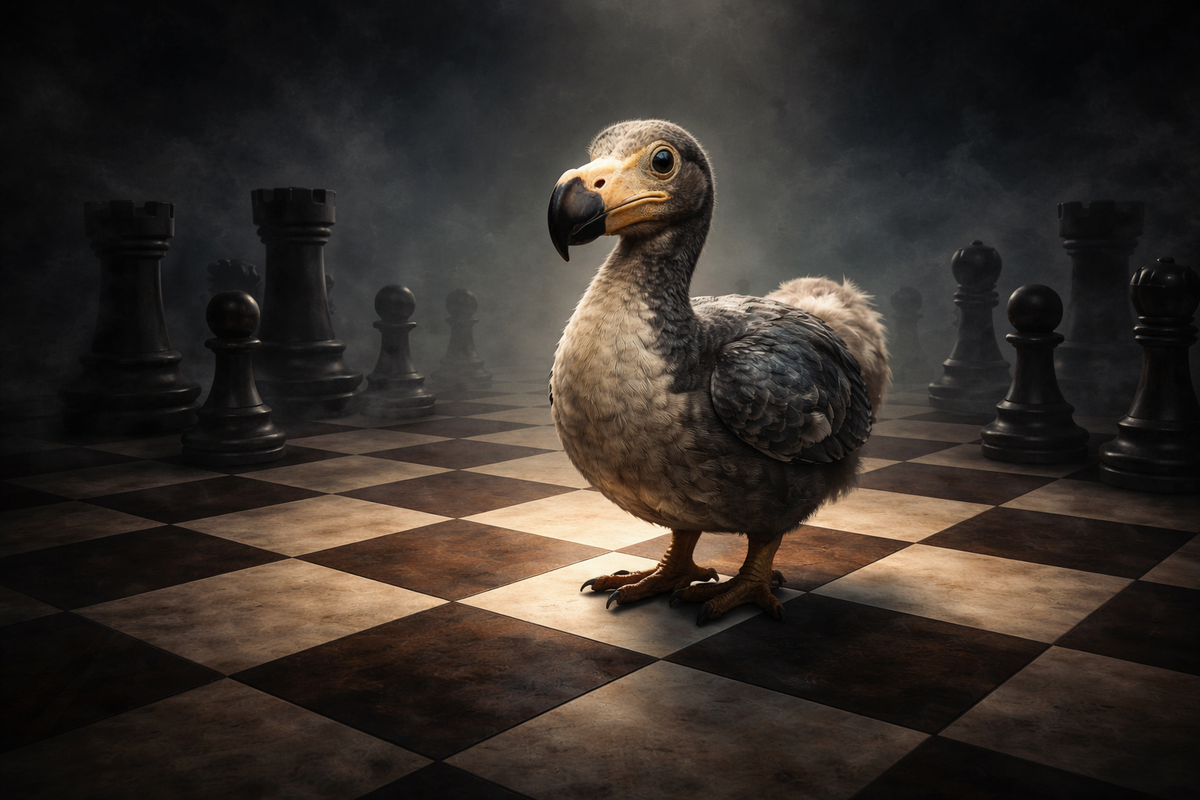
The dodo was a large, flightless bird that lived on the island of Mauritius in the Indian Ocean. Looking at images of it, it appears almost cute, somewhat clumsy, with a round body and a large curved beak. It went extinct at the end of the 17th century, shortly after humans arrived. Today, it has become a symbol of extinction caused by human activity - but also a warning.
Thinking about the dodo and its fate, it became clear to me that it lived and evolved in an environment without predators. In its DNA, there was no record of the need to develop fear or instinctive caution toward large animals, or in this case, humans. It had no experience and no evolutionary pressure to become alert.
When humans arrived on the island, the dodo did not run away - because it did not know it should. In biology, this is called “island tameness.” When an environment provides no resistance, defensive mechanisms atrophy.
Mauritius is not the only island where this happens. Every team that fails to learn how to recognize risk becomes one.
In every team, there are those “good souls,” people who are worth their weight in gold. Those who believe everything is fine and always will be. That naive optimism is valuable, especially in difficult times when we need someone who does not give up. But such people often have not learned to recognize risk. They have not developed caution. They do not have an internal alarm.
They trust without hesitation and give trust without verification, and precisely because of that, they can easily become targets of manipulation. Not because they are weak, but because they grew up in an environment where caution was not necessary. Their lack of caution is a byproduct of their kindness and trust, which are virtues. These people are often the glue that holds a team together.
Read next: Sinister: Growing Up on the “Wrong” Side of History
The dodo had no one to protect it. But we can and should protect our most valuable people through development. And sometimes, we must also protect them from their own desire to be agreeable. We need to teach them not to accept ideas without question, to analyze consequences, and to develop critical thinking and a risk radar.
A risk radar is not distrust of people - it is responsibility toward outcomes. Developing it means learning that the question “Why?” is not an act of aggression, but an act of team protection. Just as the dodo might have survived if it had only once questioned the intentions of newcomers, so too do our people protect the integrity of the team when they learn to say: “Let’s pause for a moment. Let’s double-check this.”
Our job is not to live in fear, but to be aware. By teaching our “good souls” caution, we protect their kindness. We give them the shield that evolution denied them, so they can continue to be the glue of our team - this time with a radar that keeps them safe.
#Leadership #Teamwork #CriticalThinking #RiskManagement #NatureLessons #OrganizationalCulture #IslandTameness #DodoBird #PsychologicalSafety